
For architecture students, some of the most valuable lessons happen outside the classroom. For Angie Conwell, a fifth-year architecture student at the Illinois Institute of Technology (IIT), that meant exploring the show floor at Coverings before traveling to Brazil to help bring a community pavilion to life.
What started as a university design-build project became an opportunity to explore natural stone, connect with industry professionals, and gain hands-on construction experience. Coverings played an important role in bringing those experiences together.
Finding Inspiration and Solutions at Coverings
During her fourth year at IIT, Angie joined a design-build studio led by Professor Frank Flury. The class was tasked with designing an open-air pavilion for a community in Cachoeiro de Itapemirim, Brazil, using natural stone provided by Brazilian stone company PETTRUS.
By the time Angie attended Coverings 2026 in Las Vegas, the team had already developed much of its design. However, they were still exploring the best way to attach natural stone to the pavilion’s structure.
“I think going to Coverings, that’s mostly what I was hoping to learn,” Angie explained, describing her interest in exploring different stone anchoring systems and understanding which would work best for an open-air pavilion.
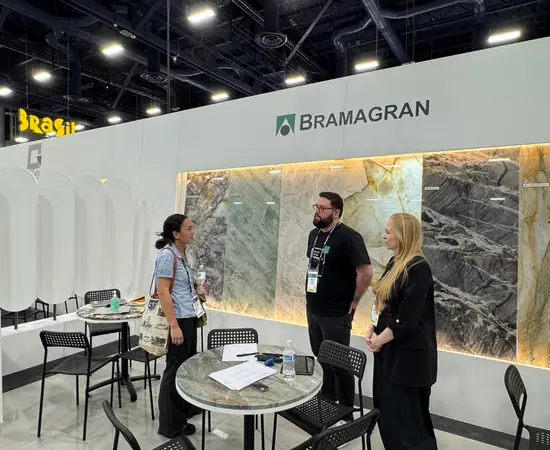
As she walked the show floor, Angie visited Brazilian stone exhibitors, learned about installation methods, and saw firsthand how companies displayed and secured large stone slabs. One of the systems she encountered at the show was similar to the solution her team ultimately used in its pavilion.
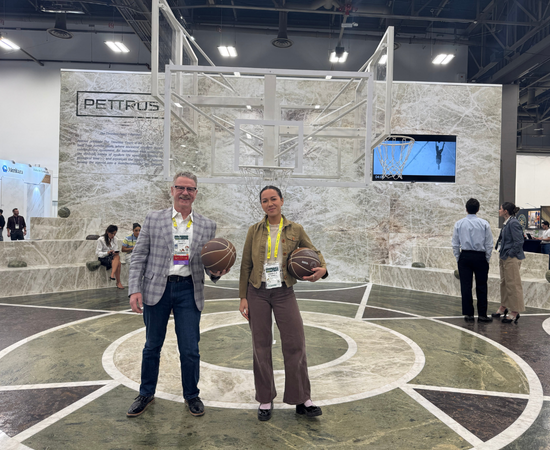
Coverings also gave Angie and her professor an opportunity to meet face-to-face with the owners of Pettrus, whose daughter had previously studied architecture at IIT.
For Angie, it was one of her first experiences participating in a professional meeting between architects and project partners.
From the Show Floor to the Construction Site
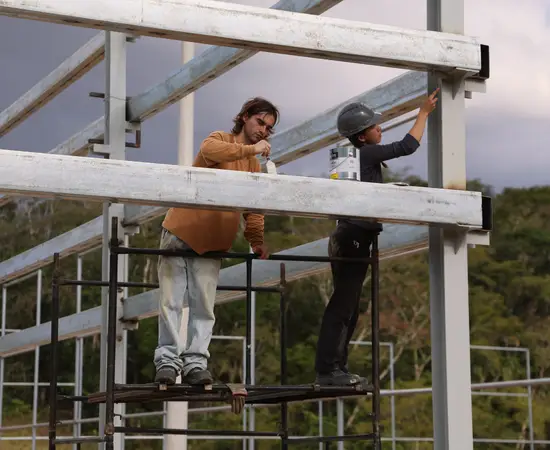
After months of planning and design, Angie and her classmates traveled to Brazil to help build the pavilion.
The project was located in the rural neighborhood of Tijuca, near a planned soccer field and futsal court. Working alongside local engineers, architects, and construction professionals, the students participated in nearly every stage of construction.
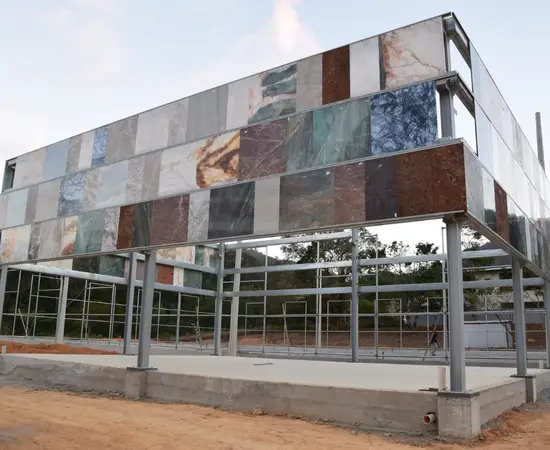
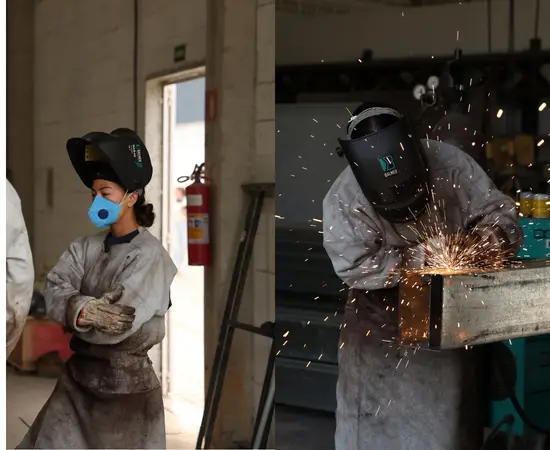
They prepared drawings, dug foundations, mixed and poured concrete, welded structural steel, and helped install the pavilion’s natural stone facade.
Angie even learned to weld during the project, gaining a new appreciation for the precision and skill involved in construction.
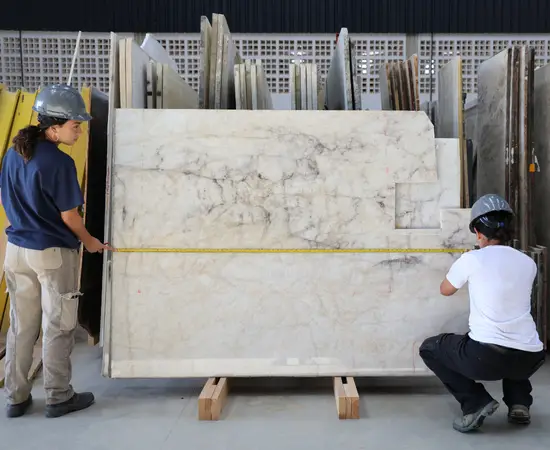
One of the most interesting parts of the project was how the team used leftover natural stone from Pettrus. The company had a warehouse of offcuts from larger slabs, many of which could no longer be used for their original purpose.
Rather than let those beautiful materials go to waste, the students measured, documented, cut, and arranged the pieces to create the pavilion’s colorful stone facade.
The result was a unique design that showcased the natural variation of stone while giving existing materials a new purpose.
Building More Than a Pavilion
While learning about natural stone and construction was an important part of the experience, Angie says the relationships she formed in Brazil left an equally meaningful impression.
Spending three months immersed in a new culture and language gave her the chance to work closely with people across different parts of the construction industry.
She was especially inspired by the respect and collaboration she witnessed between company leadership and the workers bringing the project to life.
That experience helped shape the kind of professional she hopes to become, someone who values personal relationships just as much as good design.
It also reinforced something she experienced at Coverings: the importance of connecting with people in person.
“I think interacting with people face-to-face is so important,” Angie shared. “You have to meet people, and you have to kind of get your name and your face out there.”
Why Students Should Experience Coverings
For Angie, attending Coverings offered something that can be difficult to find in an architecture program: the opportunity to focus deeply on one part of a much larger industry.
Architecture students study everything from building systems and construction methods to design and the ways people interact with spaces. Visiting a show dedicated to tile and stone allowed her to explore one material category in greater detail.
“Going to something like Coverings where you’re just kind of immersed in one trade…that is a really great learning experience,” she said.
Beyond learning about natural stone, she gained a greater appreciation for the people, processes, and craftsmanship behind the materials architects use every day.
Her advice to other students? Take advantage of opportunities to explore the industry, even when they fall outside your immediate interests. You never know when that knowledge or connection might become valuable.
Discover What’s Possible at Coverings 2027
Angie’s journey is a great example of how a single industry event can lead to new ideas, valuable relationships, and experiences that extend far beyond the show floor.
Whether you’re an architecture student, an emerging designer, or an established industry professional, Coverings offers opportunities to discover materials, learn from experts, and make connections that can inspire your next project.
Join us at Coverings 2027, April 6–9 in Orlando, Florida, and see where your next connection could take you.
Register for FREE using promo code: BLOG